
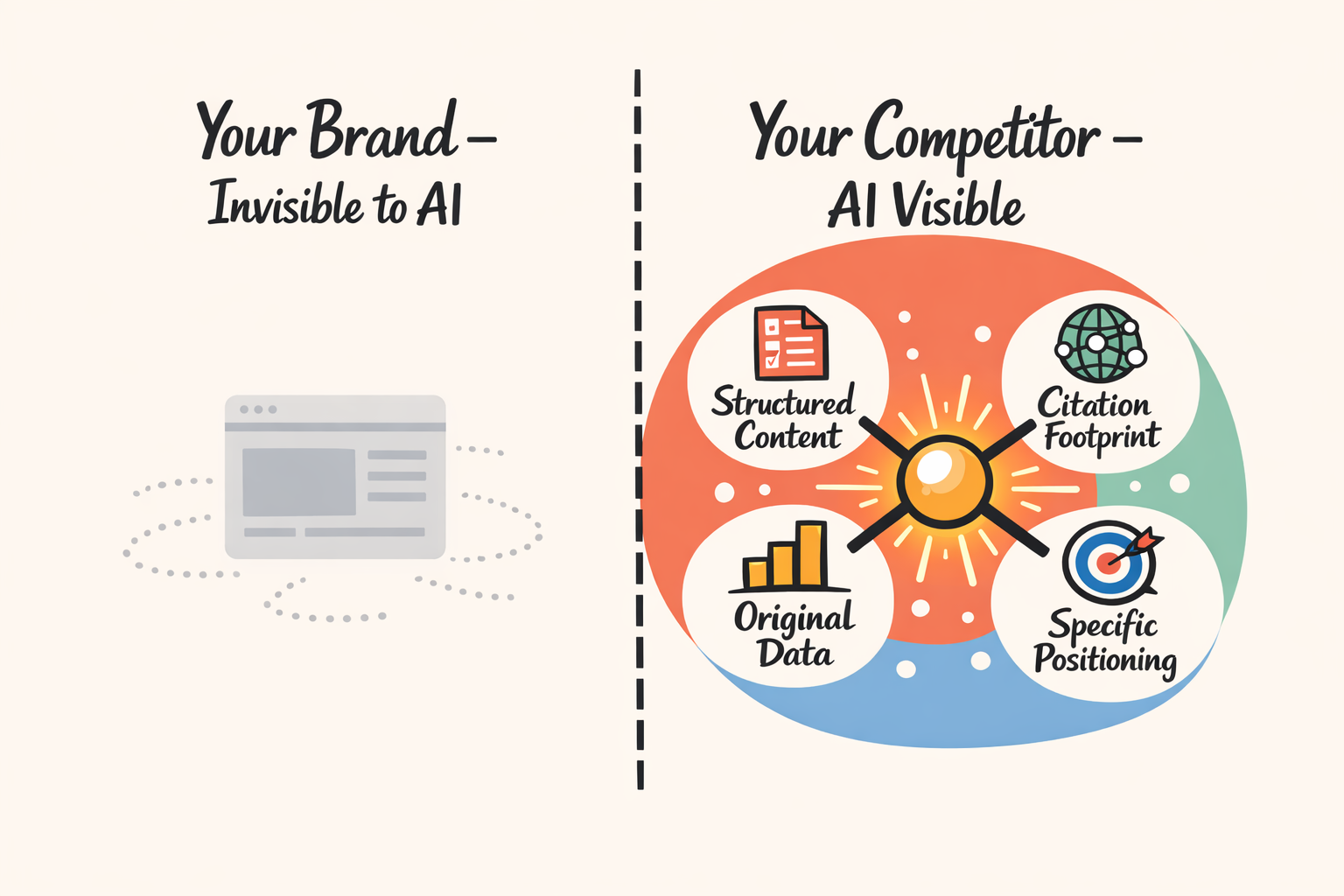
You search your category in ChatGPT. Your competitor gets named. You do not. You check Perplexity. Same result. Google AI Overviews — same competitor, no mention of you. This is not a fluke. Your competitor did something specific to earn that visibility. Understanding what they did is the first step to taking it back.
Let us break down the mechanics.
It Is Not About Being a Better Company
You might have a better product, better reviews, even better search rankings. None of that guarantees AI search visibility. AI models select sources and brands based on signals that differ from traditional SEO. Your competitor understood those signals. You have not addressed them yet.
The good news: these signals are identifiable and buildable. The bad news: your competitor already has a head start.
AI search visibility is not inherited from Google rankings. It is earned through a different set of signals entirely.
What Your Competitor Is Doing Differently
They Structured Content for Extraction
Your competitor’s pages answer questions directly in the first paragraph. They use clear heading hierarchies, bullet points, and structured data markup. Their content is easy for AI models to parse. Your pages might be well-written, but if the answer is buried in paragraph five, the model skips to a cleaner source.
They Built a Cross-Platform Citation Footprint
Your competitor appears in industry publications, expert roundups, podcast transcripts, and data repositories. These sources feed into AI retrieval systems. Every mention reinforces their authority for specific topics. If your brand only exists on your own website and a few press releases, the model has less evidence to support recommending you.
They Published Original Data
AI models prioritize primary sources. Your competitor publishes benchmark reports, survey data, and proprietary research. When users ask questions these datasets answer, the model cites the source. If you only reference other people’s data, you are always a secondary source.
They Targeted Specific Use Cases
Generic messaging like “we are a full-service marketing agency” gives AI models nothing to work with. Your competitor positions themselves against specific problems: “reducing CAC for Series B SaaS companies” or “AI search optimization for e-commerce.” Specificity creates the contextual associations that trigger recommendations. The best answer engine optimization strategies map every key use case and build dedicated content that links the brand to that exact scenario across multiple authoritative sources.
How to Close the Gap
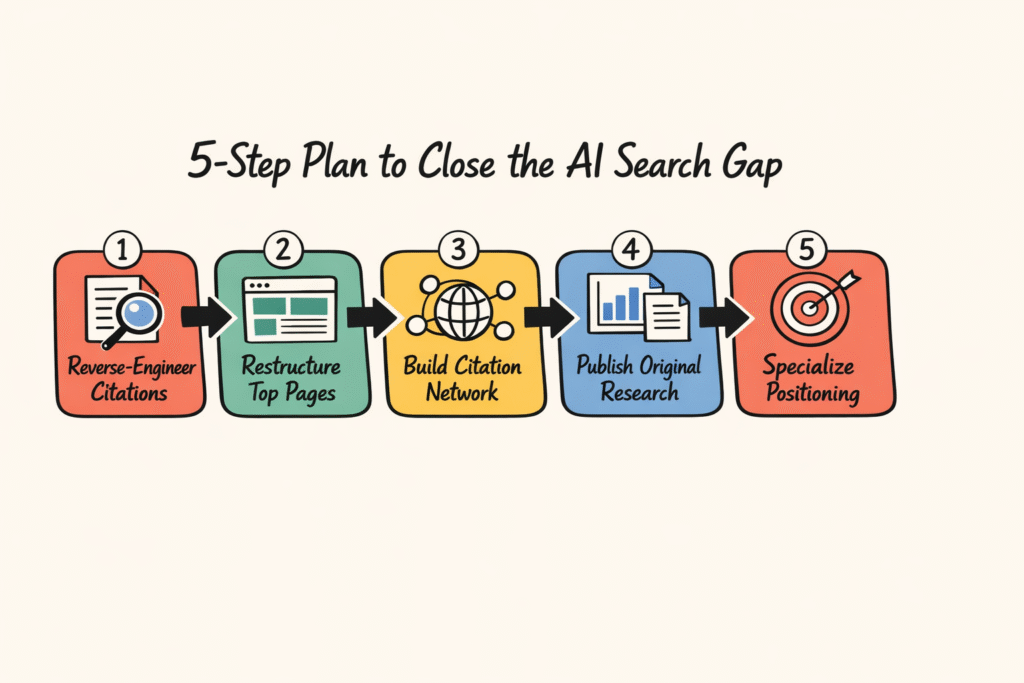
- Reverse-engineer their citations. Query AI tools with your target keywords. Note every source cited alongside your competitor. These are the publications and formats you need to target.
- Restructure your top 20 pages. Audit your highest-value pages for answer directness, heading clarity, schema markup, and list formatting. Rewrite openings to lead with the answer. AI models reward pages that reduce extraction effort.
- Launch a citation-building campaign. Get featured in the publications AI models reference for your category. Contribute expert quotes, publish guest research, and participate in industry roundups. Volume matters less than placement quality.
- Publish one original research asset per quarter. Surveys, benchmarks, or proprietary data analyses that your competitors cannot replicate. These become citable assets that compound over time. A rigorous answer engine optimization plan includes a research pipeline that continuously produces primary sources AI models can reference.
- Specialize your positioning. Stop trying to rank for every keyword. Pick five to ten specific use cases where you can build dominant topical authority. Depth on narrow topics beats breadth on general ones in AI search.
The Longer You Wait, the Harder It Gets
AI models build source preferences that compound. Your competitor is reinforcing their position with every new piece of content, every new citation, every new data point. The model’s confidence in their brand increases each month.
Starting now means you compete against a six-month head start. Starting in six months means you compete against a twelve-month head start. The math only gets worse.
Your competitor did not get lucky. They executed a deliberate strategy to earn AI search visibility. You need a deliberate strategy to take it from them. The signals are clear. The playbook is knowable. The only question is whether you start today or give them another quarter of compounding advantage.